Showing posts with label ethnic. Show all posts

Apr 6, 2014

Soba Noodle and Pork Steak with Fresh Asian Vegetables

Soba noodles are Japanese noodles made with buckwheat flour.  From what I have heard, people either really like soba noodles or they really don't like them.  I'd never tried them, but when at an ethnic market, I found a package and thought it would be an interesting experiment! 

That soba noodle package has been patiently resting on the pantry shelf for several months now, and I decided that it was time to try cooking them - no more waiting for the perfect recipe to come up!  As I was rummaging around the kitchen, I also found a package of pork steaks in the freezer that needed to be used up, and thought it would be interesting to combine the two to create a dish.  And then I needed a sauce or topping to bring it all together....

And so, 'Soba Noodle and Pork Steak with Fresh Asian Vegetables' was born.  It actually turned out really, really good (I was surprised that Charlie liked it so much!).  I cooked the soba noodles simply, brined the pork steak for a few hours, and created an Asian vegetable topping that tied everything together. 

By the way, the soba noodles were quite tasty.  They definitely had a whole-wheat-pasta-type-flavor, but I also thought they had a stronger, nuttier taste.  We loved them and I definitely plan to keep experimenting with soba noodles!  


Soba Noodle and Pork Steak with Fresh Asian Vegetables


for the pork steak

  • 1/4 cup kosher salt
  • 1/4 cup sugar
  • 2 cups water
  • sprinkling Old Bay seasoning
  • 2 pork steaks, thawed (I think pork chops might work fine as well, though I didn't try it)

for the Asian Vegetable Topping
  • 1 finely chopped carrot
  • 1/2 onion, finely chopped
  • 1/4 cup finely chopped red pepper
  • 2 - 4 tablespoons finely chopped cilantro (depending on taste)
  • squeeze of 1/2 tangerine (or 2 tablespoons orange juice)
  • squeeze of 1/2 lime (about 1 tablespoon)
  • 2 teaspoons sesame oil
  • 1 tablespoon mirin
  • 1 tablespoon seasoned roasted garlic rice vinegar
  • 1 to 2 teaspoons Thai sweet chili sauce (depending on hotness)

For the soba noodles
  • 1/2 package buckwheat soba noodles
  • 1 teaspoon kosher salt
  • 2 quarts boiling water

For the pork steak: Place salt, sugar, water and seasoning in a gallon bag.  Seal and swish around to dissolve salt and sugar.  Add pork steaks.  Place in refrigerator for about 4 hours. When you are ready to put the dish together, heat a skillet over medium to high heat.  Pan fry the pork steaks for about 8 minutes on each side, or until the internal temperature comes to 140 degrees F.  Remove to platter, cover with tin foil and let rest until you are ready to thinly slice and eat. 

For Asian Vegetable Topping: Stir all topping ingredients together in a bowl.  Let sit in the refrigerator for 2 to 4 hours to allow flavors to meld.

For soba noodles: Bring 2 quarts of water to a boil in a medium sized pot with the kosher salt.
When water reaches a rolling boil, add noodles and stir well.  As it begins to boil over, add one cup of cold water and stir.  As it begins to boil over again, turn off the heat.  This will take approximately 7 or 8 minutes.  Try a noodle - you want them to be firm-tender (or al dente) - not mushyIf they are still too firm, let them sit in the hot water for a minute until they are good.  Drain and rinse in cold water to stop the cooking process. I like to stir in a dash of olive oil while the noodles are in the sieve - it helps keep them from sticking together. 

To put it all together: You can serve this however you wish.  For presentation, I placed a pile of soba noodles at one end of a plate, thinly sliced the pork steak and arranged the topping over the whole thing.  However, when we went to eat it, we stirred it all together anyways.  If you would like, just stir together the soba noodles, the vegetables and the thinly sliced pork steak in a bowl and serve it that way. 

Apr 5, 2014

Steamed Shrimp Dumplings

Ahhh, Steamed Shrimp Dumplings, another favorite meal of ours.  We first tried shrimp dumplings at PF Changs, and I fell in love with them and wanted to try to duplicate the dumplings and sauce.  After a few tries, I came up with this recipe.  Charlie and I think that these dumplings are better than those at the restaurant!

It has been a long time I made these dumplings (probably over a year) and earlier this week we decided it was time to make them again. 

Steamed Shrimp Dumplings are actually part of a larger family of foods called "dim sum-" which is "a Chinese dish of small steamed or fried savory dumplings containing various fillings, served as a snack or main course."

All dim sum can be a bit time consuming to make, but we find the results well worth it.


To get started, you need thawed raw shrimp that has been roughly diced.


This is the shrimp dumpling filling ingredients - minced carrots, green onions, shrimp, fresh garlic, fresh ginger, and seasonings.


The bamboo steamer.  I do use a bamboo steamer to make these shrimp dumplings and other dim sum, but you don't have to have one - you could also use a well greased metal steaming basket.  Or, you could skip the steaming aspect and pan fry the dumplings like I do for my pot stickers


If you do use a bamboo steamer, make sure to place a piece of parchment steamer liners in the bottom of each basket.  I also lightly grease them with just a spray of non-stick cooking spray to ensure easy removal of the dumplings.  These steamer liners can be reused through all of the shrimp dumplings in this batch. 


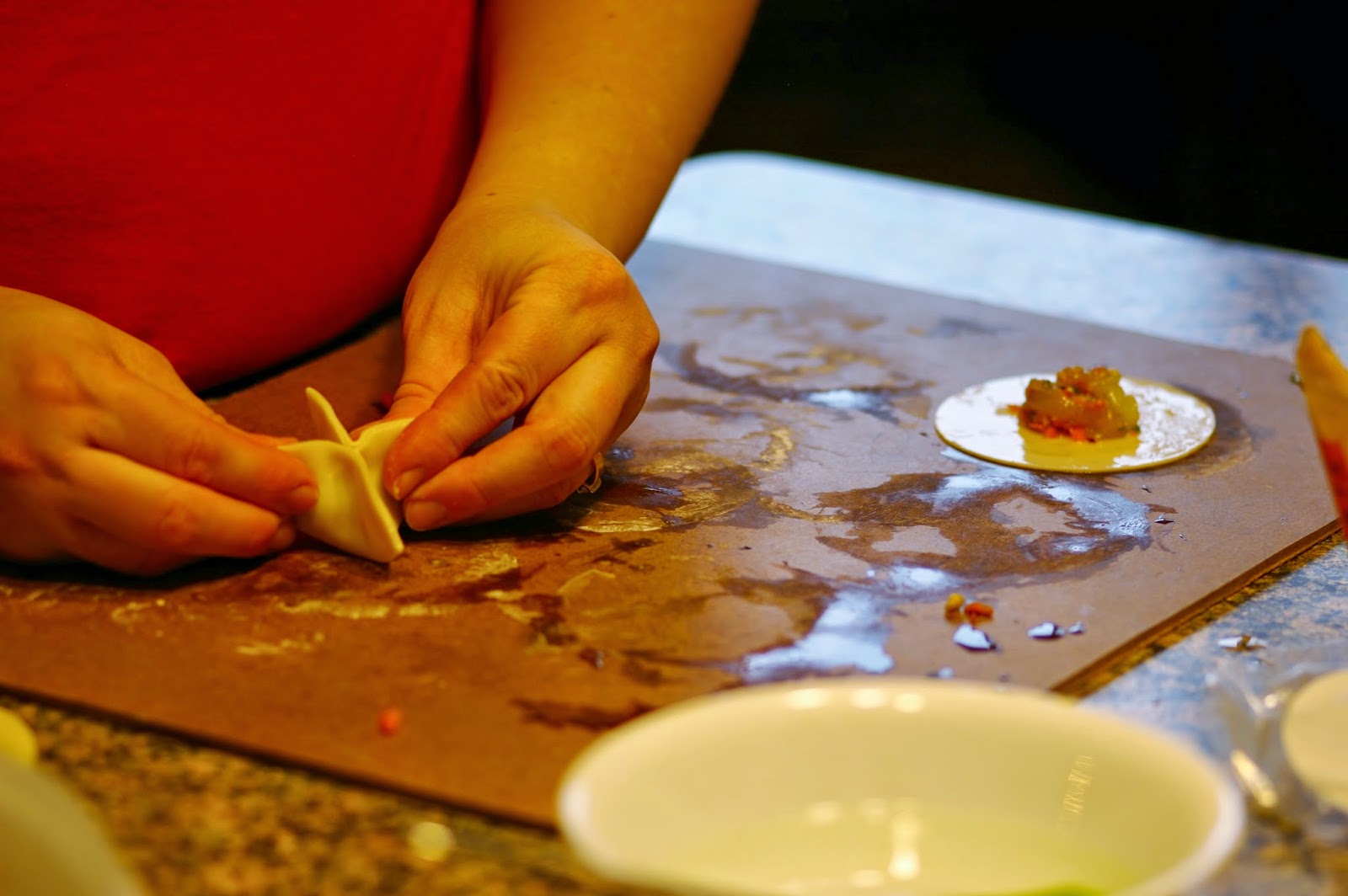
Now on to the filling.  You will notice I have a round wonton wrapper - it is actually a pot sticker wrapper.  I would recommend going with square wonton wrappers.  I usually use the square wrappers for shrimp dumplings, I just happened to have round wrappers on hand.  Anyhow, place about a teaspoon of filling in the middle of your wrapper.  (credit to: Photo Assistant Charlie who took these next few shots)


Spread a little water around the perimeter of each wrapper.


The dumpling, ready to fold.


Start the fold by bringing up to opposite sides of the wrapper.


Keep bringing the dough in toward the center of the dumpling - for your end result you want the fold to look like a 't.'


Hopefully you can see that I am pressing all the corners to the middle. 


Make sure the air is squeezed out of the dumpling.  (note: please don't mind my pregnant belly trying to get in on the action here!)


And give the seams a final good squeeze. 


Tada! 


This is what your dumplings should look like. 


Time to fill the bamboo steamer!  You will actually only be cooking one layer at a time, but it is nice to have the next layer filled and ready to go.


Aren't they beautiful?


To cook the dumplings, I use a large skillet that has 1 or 2 inches of water in the bottom.  Bring that to a simmer and place one layer of the steamer basket in it - yes, directly in the pan.  Steam the dumplings for 7 or 8 minutes.  And make sure that your skillet of water doesn't boil dry - I have found that with each new batch of dumplings I add another cup or two of water to the skillet. 


Now, it is time to eat!  See how beautiful and translucent steaming makes the shrimp dumplings?


We love the dumplings served with this delicious sauce - fresh ginger, garlic, and soy sauce mixture - I've included the recipe at the bottom of this post.


Doesn't this make your mouth water? 


Steamed Shrimp Dumplings


  • 1 - 12 ounce package wonton wrappers(square preferred)

filling
  • 1 pound raw peeled and deveined shrimp, thawed and roughly diced
  • 2 tablespoons minced fine carrots
  • 2 tablespoons minced fine green onions
  • 1 teaspoon minced fresh ginger
  • 1 teaspoon minced fresh garlic
  • 2 tablespoons sesame and garlic sauce
  • 1/4 teaspoon sesame oil
  • 1/4 teaspoon salt
  • 1/4 teaspoon sugar

sauce

  • 1/2 cup soy sauce
  • 1 tablespoon seasoned roasted garlic rice vinegar
  • 1 teaspoon Thai sweet chili sauce
  • 1 tablespoon sugar
  • 1 teaspoon minced fresh ginger
  • 1 tablespoon sesame oil
  • 1/2 cup water
  • 1 tablespoon minced fresh cilantro
  • 1 tablespoon finely chopped green onion

Combine shrimp filling ingredients.  Cover and refrigerate for an hour.  To make your dipping sauce, combine all the ingredients in a small saucepan - except the fresh cilantro and green onion.  Bring to a simmer and simmer about 5 minutes.  Let cool and refrigerate until ready to use. When ready to use, stir in cilantro and green onion, or sprinkle on top of the sauce.

When you are ready to start your dumplings, take a small spoon or small cookie scoop, and place about a teaspoon of shrimp mixture into wonton wrapper.  Moisten outside edge with water.  Fold corner to corner to form a cross or a 't' shape and seal.  The top should look like cross.  If you wish, forming the dumplings can be done a bit ahead of time.  Just place them in an airtight container in refrigerator until ready to cook and serve.  Or, just cook them right away.

Place about 2 inches of water in a large skillet.  Bring water to a boil, then lower heat to bring down to a slight boil.

Line bottom of Chinese steamer with a piece of parchment paper, then a light coat of vegetable oil or non-stick spray.  Place dumplings in steamer and cover with bamboo lid.   Place steamer in large skillet.  Steam 7 or 8 minutes, depending on how fast your water is simmering. Dumplings should be firm with internal temperature of 160 degrees. 

Serve in steamer or on plate, with dipping sauce. 

Jan 24, 2014

Vietnamese Pho

Have you ever eaten Pho?  (pronounced "fuh").  Have you ever heard of it?  A couple of years ago, Charlie came home from work and said he had heard about an interesting thing on the radio.  They were talking about the Vietnamese national soup, Pho, and, he said it sounded really tasty.  Since I love to experiment and cook new foods, I decided to do some research and give it a try.  Our first taste of pho was amazing.  Even though the soup is quite a bit of work to put together, we decided it was totally worth it - plus one batch is quite a few meals.  Let me share with you how we make our pho.

The finished pho, ready to enjoy! 


The pho spice mixture: dried chili pepper, whole fennel, a cinnamon stick, whole coriander, whole star anise and (since I didn't have any whole) ground cardamom. 


I pack these spices in a little cotton spice bag and they are ready to add to the broth.  


I couldn't resist playing around with the star anise - isn't it a beautiful spice?


By the way, I LOVE these little cotton spice bags.


Now, onto the ginger and onions.  I brushed the cut sides with oil, and next, they will be charred under the broiler.  


The charred ginger and onion imparts a great flavor and color to the broth.


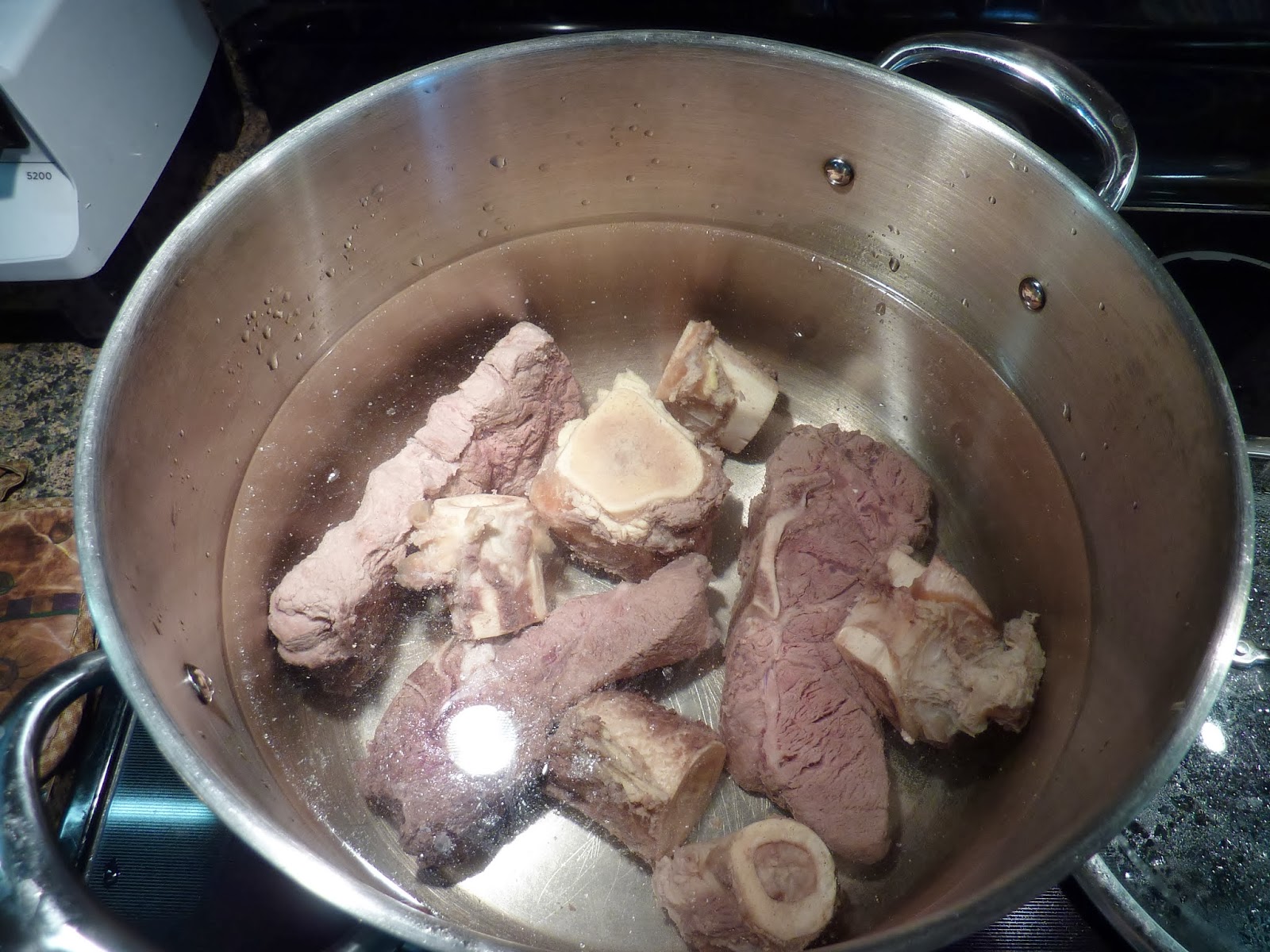
The first part to making the broth is to parboil the bones to remove impurities.  The bones: look at that beautiful marrow.  Sometimes I add a few chunks of cheap beef to the broth, just to give it some extra flavor.  For this batch, I also added some beef neck chunks of meat.


The impurities - also called "scum" - rising to the top while parboiling the bones. 


Then, dump out the icky water and rinse out the pot and rinse the bones/meat.  Add them back to the pot with 6 - 7 quarts of cool, clean water and bring back to a boil. 


Add the charred onions and ginger, the spice bag and salt, sugar and fish sauce. 


As the broth is simmering, you might get more scum.  Try to spoon off as much as you can-


Until you can see just beautiful broth.


Next, time to prepare your fresh salad.  Cilantro is a must.


Add whatever else you feel like for the fresh salad: here, I have cilantro, fresh snow peas, fresh bean sprouts, chili peppers and fresh lime wedges.


For this most recent Pho Fresh Salad, I have added sliced fresh onions, sliced green onions, red peppers and mixed greens to the "regulars." 


After you finish the broth and the fresh salad, it is time to put together the meal.  Start with thin slices of beef -


And place them in your bowl - yes, raw.  Bear with me.


Then, ladle the boiling broth over the raw meat.


As you can (hopefully) see from this picture, the boiling broth gently cooks the meat to perfection. 


Next, the rice noodles.  Add a few to your bowl.  Or, you could add a whole bunch if you want.


The wonderful thing about pho is that the meal changes as you eat.  Add a handful of this, and a dash more of that.  The following pictures are bowls of pho at various meals and at various times throughout the meal (just to give you an idea of how it works). 


I have to admit, I cheat a little.  Rather than just using chopsticks, I also use a spoon to scoop up that delicious broth.  Can't let it go to waste, right?


The flavors are rich, meaty, spicy and fresh, all at the same time.  Of course, since you are making your "own" bowl, you can change the flavors to whatever you want.


Yum! 


Pho

The broth:
  • 2 large yellow onions, halved
  • 4 - 6 inch piece fresh ginger 
  • about 6 beef leg bones (the bones with more marrow make a tastier pho)
    • Note: (as you might notice from my pictures, you can have some chunks of meat in your broth as well, to help give it a little more flavor) I added 3 chunks of beef neck meat
  •  1 to 2 tablespoons sugar
  • 1 1/2 tablespoons kosher salt
  • 1/4 cup fish sauce
  • a spice bag with:
  • 1 cinnamon stick
  • 1 tablespoon whole coriander seed
  • 1 tablespoon whole fennel seed
  • 5 whole star anise
  • 1 whole cardamom pod (or 1 teaspoon ground)
  • 6 whole cloves  
  • 1 dried chili pepper
First, char your onions and ginger.  This helps sweeten and mellow the ingredients.  Raise your oven rack to the highest setting and  preheat broiler.  Place halved onions and halved ginger on cookie sheet, and brush some cooking oil on the cut sides.  Broil on high until charred, turn over and continue to char - this should take 115 to 20 minutes total.  Set aside. 

Next, parboil the bones.  Bring a large stockpot of water to a boil.  Add the bones and keep the heat on high.  Parboil bones for a good 10 minutes in rapidly boiling water to get rid of impurities - they will look like a grayish/whitish foam floating up to the surface. After 10 minutes, dump out all of the water, rinse out your pot, rinse the bones, and refill with 6 quarts of clean, cool water and the bones/meat.  This will help create a clear, delicious tasting broth.  Bring the bones and water back to a boil, and lower the heat to a simmer - you really don't want this to boil any more.  Using a ladle or fine mesh strainer, remove any scum that rises to the top. 

Now, to your pot (that has the parboiled bones and clean water in), add the charred onions, the charred ginger, the sugar, salt, fish sauce and the spice bag.  As the broth is simmering, you might be able to see some more of that "scum."  Try to use a fine strainer or a spoon and strain out what you can. Simmer the broth for 3 hours.  Pour through a fine mesh strainer to remove the onions, ginger, bones and any bits of onion skin, ect... that might be floating in the broth.  Return the broth to the pot and taste - add more fish sauce, salt, sugar, ect... until the broth the flavor shines.  Continue to simmer for another 1/2 to 1 hour.  Now, time to make the soup!


The Soup Ingredients

  •  About 1 pound very thinly sliced flank steak, London broil, sirloin or eye of round steak
  •  Rice noodles (as you could see, I used the thin, flat rice noodles)
  • condiments such as Sriracha sauce, plum sauce and Thai Sweet Chili Sauce

To thinly slice meat, freeze the whole piece of meat for 15 minutes or 1/2 hour, and slice across the grain. Prepare rice noodles according to package instructions.


The Fresh Salad Ingredients

  • fresh lime wedges
  • fresh cilantro
  • fresh snow peas
  • fresh greens 
  • fresh bean sprouts
  • sliced fresh red pepper
  • sliced onion
  • sliced green onions
  • what else would you like?
The fresh salad can be as versatile as you are.  What fresh veggies do you like to eat?  What do you have around?


Putting It All Together

Make sure your broth is at a good simmer.  Have the rest of your soup ingredients ready at the table - the meat, the rice noodles, the fresh salad and the sauces.  Place raw meat slices in bowl and quickly add the simmering broth.  Add rice noodles, fresh salad and sauces to taste.  Time to start enjoying!  The thing we love about this is the meal is able to evolve - feel like a little more cilantro?  Add a bit.  Add some more fresh bean sprouts, or a squeeze of Sriracha or Sweet Chili Sauce.

I hope you enjoy your Pho as much as we do!